Saturday, September 19, 2020

Psiioniics II: The Diiscussiion


Click for a PDF version of the rules

Here are a couple paragraphs of elaboration on the PSIONICS rules from the last post.

This might be a contentious opinion but I think psionics are cool and good, actually. The only issue is that they can't seem to be implemented right. Every "official" psionics system I've played with is a total drag and all the homemade attempts to remedy them never really land with me. Yet, much like classic D&D, the concept is strong enough that people just keep coming back to it. Some alternative rules are pretty good, like the ones in Carcosa, but they all suffer the same problem of just being just another per-day magic-adjacent ability with an ostensibly sci-fi flavor.

I think psionics should be fun and intuitive, because this is a GAME after all, but they should also be incredibly risky and dangerous and bizarre. The way some people feel that magic should be all occult and twisted and potentially disfiguring to those who practice it—I feel the same way about psionics. While the classic TSR-era psionic rules possess a quaint yogic Indo-Chinoiserie, I'm more interested in the violent, gross psionics from the likes of Scanners and Akira. Psionics are high risk and high reward. If you push them too hard, they will push back. But the only way to grow your power is to push yourself right up against the limit.

This system was designed to have a built-in control to prevent players from using their powers excessively, but still allowing for them to actually feel like they possess meaningful abilities. One thing D&D could use more of are attrition mechanics that aren't determined by the number of [spell slots/torches/rations/etc.] a PC has left but instead by the player's knowledge that the more benefits they extract leads to a higher risk that something bad happens to their character. It's like a second psychological mind game players with psionic PCs play on top of the one they're already playing with the rest of the group.

The rules themselves are pretty easy to suit your tastes. If you want them to show up even less frequently than rolling a d100 below your lowest out of INT, WIS, and CHA you can just do it the way AD&D does it. If you want less flash, you can remove the additional environmental effects from psychic breaks and maybe tone down the two power roll abilities. I had a specific genre flavor in mind when making the powers, but if that's not your thing the system allows for modification.

The unique dice mechanic is something I'm pretty happy with. It doesn't seem to be too much extra book keeping for the players, and it serves to really emphasize the idea that psionics are weird and different, unlike all the other weird and different things featured in the game. I've already discussed my love for unique resolution mechanics, so just know that this one fits the bill. I would imagine that the power dice mechanic could be refitted for something else pretty easily, but I haven't tried it with anything else yet.

One final note: In any other psionic system, psionics don't show up nearly as frequently as they ought to. It makes sense that psionics should be rare, but when there's less than, say, a five percent chance for a new PC to be a psion then in practice the rules barely even matter to me. Inevitably, in accordance with the laws of karmic irony, a PC with psionics won't be rolled until at least six months into a campaign, and then they'll die a handful of sessions later after having barely used their powers. It's just the way these things go.

Monday, September 14, 2020

Rules for PSIONICS


ARE YOU A PSION?

After determining ability scores at character creation, roll a d100. If you get below the highest score out of your Wisdom, Intelligence, and Charisma, you are a PSION. Roll randomly for a power. If you would rather have fewer psions in your game, roll below the average of the three scores, or below the lowest of the three. 


HOW TO USE PSIONICS

Every psion has a POWER DICE, determined by their level.

  • Level 1-3: d4
  • Level 4-6: d6
  • Level 7+: d8

To use a PSIONIC POWER, roll your POWER DICE and write down the result somewhere on your character sheet. For an enhanced effect (as specified in the ability descriptions), make two POWER ROLLS and record both results. The power then manifests. Rolling repeat numbers will result in a SHOCK, detailed below.


PSIONIC POWERS

Unless otherwise specified, each power's effect applies instantaneously, with a duration of one round and a range (if applicable) of 120'.

  1. Clairvoyance: Your psychic power manifests as a supernatural second sight, allowing you to see through walls, view the contents of containers, and detect fine details. Two power rolls can be made to sense aspects of the world beyond mundane understanding such as the abilities of a creature and the features of a magic item.
  2. Clairaudience: You can achieve full sonic perception. Using this ability gives you perfect echolocation, effectively granting omnidirectional awareness as long as you can hear. Alternatively, you can choose to tune your hearing to a specific target, like a whispered conversation in a crowded room or the footfalls of a mouse in a rainstorm. Two power rolls can be made to “hear” the latent psychic energy that exists in all organic material—functioning as a one-way Speak With... spell directed at a specific organism or organic object, where the target can speak with you but you can make no response. Clairaudience lasts 1 turn.
  3. Pyrokinesis: Your psychic energy can excite particles to combustion. Attacks with Pyrokinesis have a range of 60’, use the ranged attack bonus, and deal 2d6 damage. Two rolls can be made to combust a target and cause the damage automatically, although there is a 1-in-6 chance that you ignite as well and take an equal amount of damage. 
  4. ESP: You can detect the presence of minds and read the surface thoughts and emotions of a target. Two power rolls can be made to perceive another location within 60’, such as an adjacent room or the interior of a closed box. 
  5. Telekinesis: Your mind can push, pull, lift, or hold with a force of  up to 20 pounds. An additional power roll can be made for finer work, although line of sight is required (so no squeezing hearts or slicing brains). Additionally, the max weight capacity of your Telekinesis increases by 60 pounds for every additional power roll you make. If you need a quick and dirty way to calculate attacks with Telekinesis, assume attacks use the ranged attack modifier and deal damage equal to the power roll(s). Lasts for as long as the user maintains concentration.
  6. Psychometry: You can touch an object to “read” its history. You understand its purpose and function, as well as the circumstances surrounding its creation and any notable events it took part in. Two power rolls can be made to glean more details, or focus in on one specific event in the object’s history and see the event through its perspective. 
  7. Telepathy: Psychic communication. Brief one-way messages can be sent to people you share a language with without a power roll at a range of up to 1 mile, as long as you have at least one psionics number written on your character sheet. A power roll can be made to establish a telepathic link with other people, allowing for two-way communication between a number of minds equal to your level with a range of up to 10 miles, which lasts for one hour. Other psions and particularly brilliant individuals can attempt a save vs. spells to resist telepathic communication. Two power rolls can be made to thoroughly read a target’s mind or search their memory. The target can save vs. magic to resist, but they receive a -1 penalty for every one HD you have more than them.
  8. Precognition: After rolling your power dice, you can "retcon" any decision or action you make for the next in-game minute. Consequences are adjusted accordingly. If two power rolls are made, the precognition extends to one turn and you can replace any d20 roll you make with either a 1 or a 20. The enhanced power roll ability can only be used once a day. 
  9. PSI Blast: You can use your psychic power to assault an enemy’s mind. Deals an amount of damage equal to your power roll. If two power rolls are made, deal an amount of damage equal to the higher of the two dice and add an additional effect to the PSI Blast (d6): 1. target is dazed the next round and cannot attack 2. target gets knocked to the ground 3. target gets a -1 penalty to attack and damage rolls for one round 4. target is frozen in place, unable to move for one round round 5. target is temporarily maddened and spends their next round attacking the nearest creature (attacking themselves if no one is in range) 6. target is forced to make a morale check at a -2 penalty. Other psions and particularly brilliant individuals are allowed a save vs. magic to negate the damage. If the damage is negated this way by a psion, the power roll result is not recorded. Instead, the opposing creature can spend their round to attempt a free PSI Blast against the original psion, using the original result of the power dice +1 to calculate damage. The original target is then allowed a save, and if passed they can repeat the process on their turn using the original power roll result +2, and so on. If either psion gets interrupted, the damage is split between the two of them and each gets a save vs. magic to negate it.
  10. Psychic Barrier: Through supernatural focus you can create a mental barrier to shield your psyche. Using this ability automatically negates any effect that can charm, cause fear or otherwise afflict your mind. This ability can also be used to cancel any other psionic effect, such as ESP and PSI Blast. Furthermore, due to the mental control this power allows you to exert, it can be used to reduce incoming damage from a single target by an amount equal to the result of the power roll. Two power rolls can be made to momentarily project a barrier of force around you—all matter not worn or carried is repelled from the barrier, negating any damage from physical attacks. This ability has no duration, instead it should be treated as an instantaneous reaction to attacks or effects. 
  11. Hypnosis: After at least one minute of interacting with a creature you share a language with, you can make a verbal suggestion which the target will be inclined to obey. The suggestion cannot be something that would obviously put the target’s life at risk or directly endanger their friends and allies. An additional power roll can be made to induce a sensory or emotional effect, such that the target would feel they are covered in insects, incredibly warm, remarkably angry, etc. This effect lasts for a number of minutes equal to the sum of the two power rolls. Alternatively, an additional power roll can be made to put intelligent creatures to sleep, functioning the same as the Sleep spell affecting a number of HD equal to the sum of your power rolls. You and the target(s) must be able to see each other. Creatures that are hostile to you, along with other psions or people with remarkable intelligence, can resist hypnosis by succeeding on a save vs. magic.
  12. Physical Augmentation: You can use your psionic power to consciously control and enhance your bodily processes. For one round, you can move twice as fast and gain a bonus equal to the result of your power roll to your AC, attack rolls, and any physical ability test. Alternatively, you can heal a number of HP equal to the result of your power roll or receive a bonus to any save against poison, drugs, and the like. If two power rolls are made, you enter a trance-like state where the effects of Physical Augmentation last for two turns. At the end of the two turns, you must succeed on a Constitution test (without the benefit of the bonus) or else become fatigued until you get a full night’s rest—all ability tests and attack rolls are made at a -1 penalty, and you move as though you are one level more encumbered. 


SHOCKS AND BREAKDOWNS
There is no hard limit to the amount of times you can use your abilities. That being said, excessive use can and will cause setbacks. 
  • If you make a power roll and get the same result as one you have already written down, or make two power rolls and get doubles, cross the repeated number out with a slash and suffer a random SHOCK, detailed in the table below. The ability still manifests. 
  • If you make a power roll and get a number you have already crossed out, cross the number out again to form an X. You suffer a shock and fail to manifest the ability. 
  • If you continue to roll and get a number that has been crossed out with an X, the power manifests and you suffer a PSYCHIC BREAKDOWN immediately after.

PSYCHIC SHOCKS

  1. The release of psionic power creates a storm in your brain, giving you a minor seizure. You fall to the ground and are effectively incapacitated for 30 seconds. 
  2. Blood vessels burst in your head, causing blood to pour out of your nose, eyes, and ears. Take 1d6 damage. If you were to die from this damage, you instead pass out and wake up an hour later with 1 HP.
  3. The mental effort leaves you with a splitting headache. Every attack roll and ability test you make for the rest of the day suffers a -1 penalty. 
  4. The voices in your head are getting louder... for the next hour, any activity that requires careful focus and attention to detail (searching for a trap, listening at a door) automatically fails. 
  5. Your higher-order thinking slips away, leaving you in a state of heightened suggestibility. You must follow the commands of anyone that succeeds on a charisma test, as long as the command isn’t directly harmful to you or your friends and allies. This lasts for 1 hour, after which you only have a vague, hazy memory of what occurred during that time.
  6. The release of psychic power causes parts of your brain to stop functioning properly. You lose sense functionality for one turn: d4 — 1. Sight 2. Hearing 3. Touch 4. Smell and taste.  
  7. Your subconscious mind creates a temporary mental block as a response to built up psychic trauma. You are unable to use psionics for the rest of the day.
  8. You overexert your mind and your psionic powers run wild. Write down another number as if you had made another power roll and channel an additional random psionic power. If all the numbers of your power dice are already written down, cross one out and suffer an additional setback.


THE PSYCHIC BREAKDOWN

Psychic breakdowns are incredibly traumatic, life-altering events, but they can give way to new insights and abilities. When you suffer a psionic break, roll a d100.


1-60: Roll 1d4 and subtract the result between your Intelligence, Wisdom, and Charisma scores. A tremor shakes the immediate area.

61-70: As above, and lose one known language. Every sentient creature within a 100’ proximity must save vs. magic or take 1d6 damage.

71-80: As above, and lose half the experience you have gained since leveling up. You seep unstable psychic energy, causing every mechanical or magical device within 100’ to go haywire.

81-95: As above, and you gain 1d4 mutations. You release waves of sheer psionic power in a 10 mile radius. Carts and wagons begin to levitate, weather systems are disrupted, animals go insane, babies are born already knowing how to speak. 

96-100: Immediate death. If you are level 7 or higher there is a 1-in-6 chance you erupt in a massive, terrible explosion, obliterating everything in a half-mile radius.


After suffering a psychic break, you fall unconscious for 1d6 days and gain one random psionic power upon wakening.


ACQUIRING MORE PSIONIC POWERS

In addition to acquiring a new psionic power after surviving a psychic breakdown, you also gain a new random power when  every number of your power dice is written on your character sheet (including ones crossed and X'd out). This can only happen once per level. More powers can potentially be acquired if you receive training from a master psion. The parameters of training are left up to the DM.


MELLOWING OUT

You can spend a full day to mellow out, which lets you erase one number from your sheet. You can’t spend the day doing anything other than basic activities like going for a walk, meditating, nursing your migraine, etc. You can also speed up this process by partying, doing drugs, donating to the needy, or whatever other frivolous moneysink best suits your character. Spend a number of sp (assuming a silver standard) equal to 10 times your level and roll your power dice. Erase an amount of numbers equal to your result. 


Friday, August 28, 2020

CAN A CAMPAIGN BE "ABOUT" SOMETHING?

THE ANSWER MAY SHOCK YOU!

In the Last Planet, all the gods are dead. Many of them died in great cosmic wars, some were turned to stone by the Antimatter Basilisk, and others simply fell too deep into obscurity and descended from their godhead. The very last to die were subsumed by the hyperintelligent black hole slowly devouring the universe.  

There are a couple reasons why I wanted the setting to be this way, but the "point" is because I want my friends to feel like this world is different from the various fantasy genre (high, weird, grimdark, etc.) settings they're familiar with. They assume that a fantasy world will have fantasy gods, so it should tell them something when there aren't any.

Most of the decisions that went into making the Last Planet were things that I sort of just settled on and came up with justifications for later on. I feel like this is probably the case for 90% of every game ever. 

D&D and its counterparts can generate a lot of different and interesting stories, but I don't think they are well equipped to convey certain standard narrative elements—specifically, themes. You can have a plot, and it's really easy to convey a tone, but to try and make a campaign "mean" a specific thing? Good luck. It can be hard enough to consistently articulate an overarching message in conventional narrative forms, let alone in a collaborative imagination game. Some designers in attempt to achieve this through less game-centric mechanics focused on character development (hence storygames), but the way old school D&D is played, with its emphasis on player agency and lateral problem solving, makes it uniquely bad at establishing a cohesive theme. 

Without having all your players sign on to your vision, actually having a theme isn't feasible. Themes are generally conveyed in stories by the outcomes and repercussions of plot events. In games, where "plot events" are determined by dice and it is up to the players to decide how to deal with them, you'll undoubtably need to resort to the loathed practice of railroading to get your point across.

It's been said many times before that D&D campaigns are closer to picaresques than standard adventure stories. While I agree with this, I feel it can be misleading. D&D campaigns are similar to picaresques in the episodic nature of the adventure-downtime gameplay loop, but a campaign is a cohesive thread of events that develops as the players interact with the game world, with an emergent cause-and-effect chain of consequences that are rather unlike most picaresques whose episodes usually play at the same ideas or concepts but from different perspectives. A story definitely emerges in a campaign, but not necessarily a capital-N Narrative like the kind you read in books.

I know this isn't groundbreaking stuff—anyone who has DMed a couple sessions understands this intiuitively. But here's a SHOCKING REVERSAL that will lead to a THOUGHT-PROVOKING CONCLUSION:

Maybe you can't make a game emulate the trappings of a narrative, but perhaps through tuning the campaign elements—the settlements, the NPCs, the encounters, the faction drama, etc.—toward a specific idea, belief, or big question, something resembling a theme may arise. 

One probably wouldn't want to tune their campaign too explicitly, because that would get really tired and same-y after a while. Instead, they should just use the "theme" as the guiding idea that orients the campaign.

One thing I want to capture in the Last Planet campaign is the same sense of absurdist nihilism present in Jack Vance's Dying Earth series. Of all the qualities those stories have to be enamored with, I was particularly taken with the ever-present sense of weird pseudo-nihilism that suffuses just about every page of every book. The sun is about to go out and everyone knows it. But that doesn't stop people from caring about things, it just meant that their cares are absurd and often frivolous. There's that guy Cugel met on the beach who spent his life like his fathers before him looking for the necklace a distant ancestor had lost—because he wants to sell it. It says something very specific about the kind of story Vance was telling that this man presses on in his stupid, selfish pursuit despite the apocalypse potentially triggering at any moment. And you're reading it, and you're wondering what Vance's youth must have been like coming up during the Great Depression, the sort of influence that must have had on him. It's a great scene, and you can lift it entirely for your own campaign. 

I want a setting to convey that feeling. I want the players to come across figures that are weird and narcissistic both as a result of and in light of the fact that the universe will soon be swallowed by a massive black hole and there's nothing anyone can really do about it. I have no way of controlling how the players react to this, but I can control what it is they react to. In coming up with the various structures of the campaign world, I have attempted to use this idea as the main design principle. I would love to be able to speak with more authority on this subject, but I'm only now putting it in practice. I will nevertheless report back with further meditations as the campaign progresses. 

Sunday, August 16, 2020

Several GUMPTION WAFERS are depleted from your GRIT CIBORIUM

When I was at an appropriate age to be interested in such a thing, I was an avid reader of Homestuck. Andrew Hussie's multimedia web epic hit me at exactly the right time in my life and, along with many others in my specific age and interest cohort, I got swept away. Like many an eager MSPA reader I also devoured Problem Sleuth. I found the story to be quite enjoyable (needless to say, since Hussie's writing is scientifically formulated to mimic the effects of crack in the brains of a certain subset of internet-addled early-to-mid adolescents). 

click this to go to page 1

One of the things that really grabbed me were the overblown video game pseudo-abstractions that exist in what would otherwise be a purely narrative story world, a la Scott Pilgrim. They were funny because they riffed on video games and they used weird antiquated language, but also because they were a genuinely compelling idea in and of itself—at that time no one had really tried to tell a story like that before. 

The experience of reading Problem Sleuth, and to a certain extent early Homestuck, is similar to being really young and watching a friend's older brother play a video game you've never seen. Everything seems awesome and complex and all over the place, and after a little while some parts begin to fit together and you can make out a certain logic among all the action. 

You don't know exactly what every mechanic does and what they're used for, but you can piece together just enough from the context clues to have an idea about what's going on and make you want to play even more. That's what these stories capture—the sense that you're watching someone play a video game that's really fun and interesting (written by Andrew Hussie, after all), and you want to play it too. 

Part of the "joke" of these game abstractions is that they are all complex and boutique but still relatively straightforward. It just wouldn't work if the PLUCK RELIQUARY was just a health bar or the OSTENTATION DRIVE just a limit break or whatever. They are different things, and the difference is interesting. 

The point that ties this back to D&D is the appeal of D&D's resolution mechanics. While Problem Sleuth is explicitly riffing on video games instead of D&D, the same principles apply—perhaps even more so for D&D, since Problem Sleuth as a story is much closer to something out of a TTRPG instead of a video game. 

Most modern TTRPGs, including modern D&D, rely on unified resolution mechanics (meaning all checks made with the dice are done in the same manner). Meet or beat a target number on a d20, roll 2d6 to determine degrees of success, etc. It's simple game design, easy to understand, and easy to put in practice. Meanwhile old-school D&D has got resolution mechanics out the ass—roll a d20 under a number to determine an ability test, roll a d20 over a number to determine a saving throw, roll a 1 on a d6 to see if a monster pops up, 2d6 to see how it tries to eat you, d% to see if that idiot thief can finally scale a wall without falling off this time. 


The classic argument for why people favor non-unified resolution mechanics over unified ones is that different elements of the game ought to be distinguished mechanically as well as narratively. What a reaction roll represents is fundamentally different than what a dexterity test represents, so it makes sense that they should use different mechanics. I agree with this argument, but even if it weren't the case I believe I'd still be in favor of non-unified resolution mechanics. 

There's something undeniably appealing about non-unified resolution mechanics. It harkens back to those days I'd spend hunched in front of the computer after finishing my homework, flipping through the virtual pages of an overwritten web comic thinking "man, if only I could get a video game like this." Obviously it's all just rolling dice, but my simple mind is transfixed by the strange magic of tossing shapes and consulting different charts and lists. 

Rolling the same kind of dice to try to get the same kind of outcome over and over again is fine, but something about it gives me an uncomfortably plastic, smooth, Marvel movie focus group kind of vibe. There's nothing for my mind to latch on to; it's too easy to get. 

Non-unified resolution mechanics can be sloppy. They can lead to clutter, they can be difficult for players to pick up, and they could really easily lead to the dreaded rules bloat. I don't have a cunning refutation to any of these arguments, other then the fact that they're all pretty easy to spot and remedy in a game you fundamentally understand (could be a different story if it's something you're reading for the first time). And yet it's not enough to deter me. I got seven different kinds of dice, and I'll be damned if I can't roll all of them in one session. 


Wednesday, July 29, 2020

The Brollothere


The most noble steed, the greatest mount, the subject of countless legends and stories, is a creature known as the Brollothere. 

The Brollothere has the legs of a camel, the body of a horse, and the tail of an ox. Its face is long and pointed, somewhere between an okapi and a borzoi. It has loose, ivory fur and its eyes are pearly white without pupil or iris. Two golden ram horns arch around its head, which gave it its nickname “king goat.” It's a bit bigger than a clydesdale.


Its eyes make it seem as though it is unaware of its surroundings, but there's more than enough anecdotal evidence to suggest otherwise. Some have speculated that it has a supernatural sense of smell, while others posit it is mildly clairvoyant. 

The Brollothere is suited to any environment. It can climb and swim with ease and can gallop over nearly any terrain no matter how difficult. It can change it’s gait from that of a dromedary to that of a horse to best suit whatever land it traverses. Each of its legs has an additional joint right above the knee that can bend in the opposite direction, allowing for more mobility without compromising on strength. It’s faster than a race horse, tougher than a war horse, and never seems to tire (although it doesn’t like traveling at night). 


It’s possible that there is more than one Brollothere, since it has shown up in stories from all ages and cultures, but it’s generally considered to be wholly unique. After all, its commonly recognized as one of the blessed children of the Six-Eyed Unicorn, who birthed nine holy beasts to roam the world as it slowly dies in the Lake of Essence. 

Despite it’s legendary stature, the Brollothere is actually rather undiscerning when it comes to letting people ride as long as they abide by som rather stern guidelines.

  1. The rider must be of lawful or neutral alignment. The Brollothere is willing to make exceptions for those chaotically aligned, as long as their intentions are virtuous and they show adequate respect to the beast.
  2. The rider must not mount any other steed as long as they are companion to the Brollothere. The Brollothere is said to shun anyone who has chosen another mount after having ridden it, but it’s possible it can be won back over with adequate gifts and concessions.
  3. The Brollothere will not tolerate being used as a beast of burden. It is a mount worthy of a king, and will not take kindly to anyone treating it like a lowly mule or ass.
  4. The Brollothere has a strong aversion to subterranean spaces and will absolutely refuse to enter any dungeon (though due to its size it wouldn’t be able to fit in most anyway). Leaving the Brollothere on it’s own isn’t much of an issue, since it can look after itself perfectly fine. No predator ever dares attack it.
  5. The Brollothere will not attack another creature. In combat, the most it would do is shove or buck, even if its life or the life of its rider is in direct danger.


The Brollothere can survive on remarkably little food and water, but it has a special fondness for fruit—especially the golden figs that grow in the verdant oases of Harvoul. Bring it one of those and it will surely take a liking to you. 

In the most dire of circumstances, the Brollothere would let you sup from one of its six teats, from which pours a rich, golden milk. One mouthful restores 1d6+1 hp and is enough to sustain a grown adult through a whole day. The milk is discussed in gourmet societies with a reverence reserved only for the most legendary victuals. Many a charlatan has tried to peddle knockoffs as the real thing. 

Where to spot the Brollothere:
  1. Drinking from a sacred stream in a sacred grove atop a sacred mountain.
  2. Rescuing a group of orphans who are about to drown in a river.
  3. In the planar menagerie of a high-powered wizard.
  4. Ridden on by a purehearted king who’s going into battle against the villainous invaders laying siege to his small kingdom.
  5. Wandering alone among the golden sands of the endless desert. Or perhaps it’s merely a mirage?
  6. Leading a caravan of dwarves in search of a new home through an icy tundra.
  7. Off in the distance, in a dewy forest, at daybreak, silhouetted by the morning sun.
  8. Following around a motley crew of rapscallions and vagabonds who just can’t seem to get rid of it.
  9. Leaping from peak to peak with a pack of cloud goats in a misty mountain range.
  10. On sale at Farmer Lunn’s ranch. Going rate is 10,000 GP, but he’s willing to negotiate.

The Brollothere
8 HD, AC 7 [12 ascending], Attacks: shove. On a successful hit the target is knocked back up to 10’ and must save vs. paralysis or fall prone. Movement: 360’ (1.5x a standard riding horse). 

It can carry two full-grown adults in armor and gear with ease. A third would slow it down to 180’, and not much more could fit on it other than a child or halfling (whose weight would be negligible).

Monday, July 20, 2020

How to Make Rumor Tables If You're a Dummy or Really, Really Smart

ReFiend

So you've seen people talk about rumor tables or maybe read a few in published adventures. They're pretty cool and it's generally understood that they enhance your game (especially if you're running a sandbox), but there seems to be a startling dearth of material on using them. Here is a dirt-simple way to understand rumor tables and make them for your game.

When creating a rumor table, make at least one rumor on...
  1. A prominent NPC
  2. A random encounter (insight on something they might run into in the wilderness)
  3. A local spot of interest
  4. Town politics/drama 
  5. Specific lore about the dungeon or area of interest
  6. Recent event or happening 
  7. An object or artifact of value (or just a treasure horde, w/e) in the vicinity that the players would be interested in
  8. A semi-falsehood about (roll again)
  9. A semi-falsehood about (roll again)
  10. A falsehood about (roll again)
Complete this table, swap out the options with your own ideas to fit your campaign, and make falsehoods more or less prevalent according to your taste. Also randomize the results whenever you do this so that the players don't realize that getting an 8-10 on their rumor roll means that they're about to be fed some bullshit. 

Do this for every settlement your players can feasibly reach to have a d10 (or higher) rumor table ready to go the moment they step foot in town. Each category could have multiple installments, which means you can cram them all in one massive table or have nested tables like the random encounters in BX.

artcobain

This isn't strictly a top-down or bottom-up approach to preparation; it can be either depending on your preference. I prefer to have the basics of the location down before grinding out digestible rumor-sized info packets, but I can imagine it's pretty easy to use this to generate some rumor tidbits first and build out from there. 

Here's an example from a table I recently made for my campaign when the players made a delivery to some NPCs in a town called Dim Hill: 
  1. Lady Theophania von Noctum is known for delighting in odd and off-putting pastimes. She has recently developed an addiction to dreamstone dust.
  2. The people vultures might seem fearsome, but they'll leave you alone as long as you show you're not a threat.
  3. There's talk of a dreamstone den hidden away somewhere in the catacombs below the graveyard fields. It's an open secret that it exists, but actually finding it is a challenge—you probably need a map or a guide.
  4. Roving bands of unruly adolescents have started putting pumpkins on their head and terrorizing the town. They're led by someone they call King Jack.
  5. The Noctum is a region of the Cerulean Valley where spirits of the dead have never quite found rest. The air itself is so suffused with the ethereal ectoplasm built up over the countless ages that you can even see it hanging wisp-like in the air if the light is right. Theophania has ruled the Noctum since before anyone can remember
  6. Dread Ulfire has hired the Barb-Hide Boys to extort the people traveling on the road to Eagle's Reach. They're charging money for "protection" and mugging anyone who refuses to pay. 
  7. No one's been inside the Vinsler mansion since the family disappeared a decade ago. Supposedly, they left behind all the curios in their gallery and whatever other valuables they had.
  8. Lady Theophania and Dread Ulfire have a history. The two of them go way back.
  9. The Vinsler's didn't disappear, they were just cursed to be mute and invisible. 
  10. A cursed ring was dropped down the old well at the center of town, which is how the water got poisoned. 
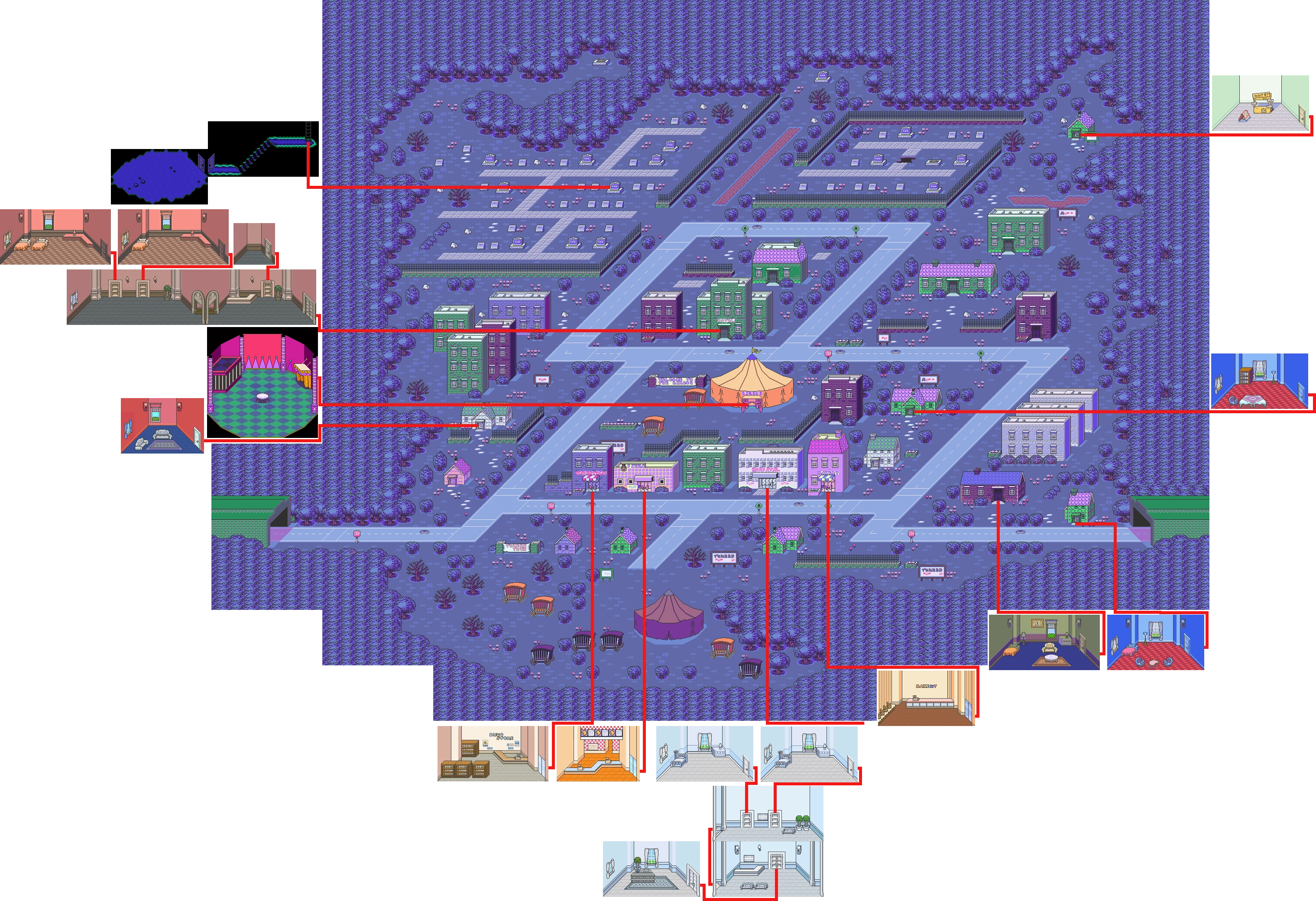
Dim Hill is kind of like Threed from Earthbound 

TAKING IT A STEP FURTHER
Rumors can be broken up into three types: Direct, Indirect, and Parallel.

Direct rumors are explicitly related to goals or things the PCs might be interested in, and they are usually immediately actionable. They are bits of information from which the PCs can actively base their next course of action on. Are multitudes of children disappearing down the old well that may or may not be a portal to the terrible dungeon dimension? A rumor describing that would be Direct. 

Indirect rumors are more intended to set the tone or provide more lore and context. They're not necessarily bits of information that PCs can use as soon as they hear them, but instead they can provide more general information and set the expectations for the sort of people and things the players can encounter in the area. If all the nobles in this city are addicted to a very specific and very illegal type of drug, the rumor that would fill the PCs in on that would be an Indirect one. 

Parallel rumors are rumors that might be actionable, but aren't strictly tied to things the PCs might be interested in accomplishing at the moment. Perhaps these could be alternative adventure hooks for the PCs if things are starting to get stale, or they might be hints at things to come. Interestingly, Parallel rumors can also act as tone-setting details in the same way that Indirect rumors are. That makes them a sort of synthesis between the two. A parallel rumor could be something like "there's a farm at the edge of town where all the animals have 12 legs." Weird, but not something the PCs immediately want or need to concern themselves with.

Jungpark

Going back to our original example, here's how each rumor breaks down:
  1. Lady Theophania von Noctum is known for delighting in odd and off-putting pastimes. She has recently developed an addiction to dreamstone dust. Parallel
  2. The people vultures might seem fearsome, but they'll leave you alone as long as you show you're not a threat. Indirect
  3. There's talk of a dreamstone den hidden away somewhere in the catacombs below the graveyard fields. It's an open secret that it exists, but actually finding it is a challenge—you probably need a map or a guide. Direct
  4. Roving bands of unruly adolescents have started wearing pumpkins on their heads and terrorizing the town. They're led by someone they call King Jack. Direct
  5. The Noctum is a region of the Cerulean Valley where spirits of the dead have never quite found rest. The air itself is so suffused with the ethereal ectoplasm built up over the countless ages that you can even see it hanging wisp-like in the air if the light is right. Theophania has ruled the Noctum since before anyone can remember. Indirect
  6. Dread Ulfire has hired the Barb-Hide Boys to extort the people traveling on the road to Eagle's Reach. They're charging money for "protection" and mugging anyone who refuses to pay. Parallel
  7. No one's been inside the Vinsler mansion since the family disappeared a decade ago. Supposedly, they left behind all the curios in their gallery and whatever other valuables they had. Direct
  8. Lady Theophania and Dread Ulfire have a history. The two of them go way back. Indirect
  9.  The Vinsler's didn't disappear, they were just cursed to be mute and invisible. Parallel
  10. A cursed ring was dropped down the old well at the center of town, which is how the water got poisoned. Parallel
These categories aren't strict, I just find that keeping them in mind helps my rumors stay fresh so that they're not all the same "weight," because otherwise your town would be a kind of WoW-style quest hub like what you find in 5e modules and that's just boring. 

JanBoruta

You might think you'd need to do the typical D&D thing where you ensure that you always have specific ratios of each type of rumor and that each rumor needs to be strictly categorized into one of the three categories, but I actually advise against that. 

The point of rumors is merely to convey information to the players and keep the game moving. It's good to keep in mind that different rumors can accomplish different things and make sure you have a good proportion of each type, but you don't really need to sweat it. As with everything, experiment with different types of rumors and see what works. 

INFORMATION, MISINFORMATION, DISINFORMATION
False rumors, like mimics and cursed magic items, should be employed in moderation. You ought to include them to keep the players on their toes and make them think critically about their knowledge, but throw in too many and they simply will stop trusting them. Many a young DM soon learns that if 50% of the NPCs they introduce stab the party in the back, the party will become skeptical of 100% of the NPCs they encounter—and that just slows the game down. 

So instead of just having rumors that are either correct or flat-out lies, consider blurring the lines a bit. A "false" rumor could be an exaggeration of the truth, or perhaps a misremembering of certain details. On the flip side, rumors could be flat-out false but still be informative. No, there aren't bandits hiding around the bend in the road waiting to mug travelers, now stop asking. Yes, Sir Dane slew the forest troll months ago, any suggestion it might still be around is preposterous. 

MichaelBrack

But don't be afraid to give false and misleading rumors, too. You shouldn't prank your players, but feeding them misinfo could be an interesting spice to add in any scenario. Maybe they show up to the river witch's lair in full scuba gear, only to find that the stream dried up weeks ago. Now they have to decide if they want to explore it in wetsuits or just call it quits and make the long trek back to town. Or maybe seek out some other aquatic adventure since they're already prepared for one. 

Czepeku

BUT WAIT, HOW DO I ACTUALLY GIVE RUMORS?
Whether you want to just tell the players some info or roleplay a whole conversation comes down to personal preference, as either method accomplishes different things. If you want to focus more on the adventures and care less about what happens in between, there's nothing wrong with just giving players a few sentences of exposition whenever they roll for rumors. 

Alternatively, if you feel as though the social/factional/RP elements of your game ought to take precedence, playing out a conversation where the content of the rumor is embedded in the responses of the NPC can add some more dimensions of complexity to the information transferring process. It allows the players to ask questions and dig deeper on things they find interesting, while also letting the DM tailor to information they provide to match who it is the players are talking to. If one character goes to the town crier for rumors and the other pays a visit to the shifty fellow hiding out in an alley, the two will probably have different attitudes and opinions toward whatever rumor-worthy happenings they tell the characters about. 

DominikMayer

The downside of RPing rumors is, of course, that it takes more time and engagement from the players. You only have so many hours in a session, so think about how much of that time you're willing to spend on having the players grill nameless NPCs. 

A NOTE ON DIEGETIC RUMORS:
I see in blog posts and modules all the time rumors written out as though they were being spoken by the person giving the rumor. This isn't a bad practice per se but in my experience on both the player and DM side of things these types of rumors lead to the same bland tablesitting as excessive read-aloud text. Here's a dramatized example:

DM: Alright so since you all want to look for rumors everyone roll a d10. Zargamax, you go first. What did you get?
Zargamax: A 6!
DM: Ok sounds good, one sec. Ahem; you see a worried-looking woman walking down the side of the road opposite you. She yells *funny voice* "The quartz-toothed morlocks are devouring our precious children! Gods above, won't someone please storm their crystalline cavern and free us from this wretchéd fate?" 
Zargamax: Hmm ok cool
DM: Thendrilon you're next. What did you get?
Thendrilon: A 4!
DM: Alright. You see, uh, a one-eyed man seated at a table outside of the bar loudly conversing with his nondescript companion. He says *same funny voice but deeper* "Well I'll be, the dirt harvest sure was fruitful this year. Ain't it a shame that we have to give most o' our crop to that sable dandy the Black Knight next time he raids our humble village?" 
Thendrilon: Oh nice ok
DM: Alright, um, Girugamesh you're next
Girugamesh, who up until now was looking slack-jawed at the table: Oh uhh I forgot my roll hang on let me do it again

And so on.

Obviously this is an exaggeration (I guess) (for the most part) but the real thing I'm getting at is that rumors should be more freeform and abstract than what a lot of written modules, etc. make them out to be. I'm sure no designer would encourage you to just read out the rumor as our DM did in the example, but the point is that's the sort of gameplay that the sort of game design leads to. Just be as smart about it as you would any read-aloud text.