Tuesday, March 23, 2021

Cyborg Generator

Here is an Appendix D-style generator for cyborgs. Enjoy. 


AC: Ascending: 14–17 (13+1d4) / Descending:  5–2 (6-1d4) 
HD: 4–9 (3+1d6) 
Attacks: 3 per round. Determine attack types below.
Movement: 120' (40')
Saves: As fighter of equivalent HD
Morale: 7, or whatever best matches the cyborg's temperament.
Alignment: Any, though often Neutral.
No. Appearing: 1 or 2d4, whatever circumstances dictate. 

Thermal Vision. All cyborgs have thermal vision.

Durable Build. A cyborg's mechanical elements make them more resilient than a typical human. Cyborgs can fall up to 50' without taking any damage, can hold their breath for up to 10 minutes, and gain a +2 bonus to saving throws against poison. Cyborgs usually weigh twice as much as a typical human.

Robot Strength. A Cyborg's melee attacks deal +1 point of damage due to their physical augmentations. 

Lightning absorption. Lightning bolts and similar electrical shocks temporarily increases a cyborg's HD and melee attack bonus by 1d6. This effect lasts for 10 minutes. Any damage the cyborg suffers during this time is first reduced from the pool of additional hit points granted.

Water vulnerability. Cyborgs sink in water and completely deactivate when they are submerged. 

Appearance and Attributes Table:

HEAD FEATURES

1.  Exposed brain tank.

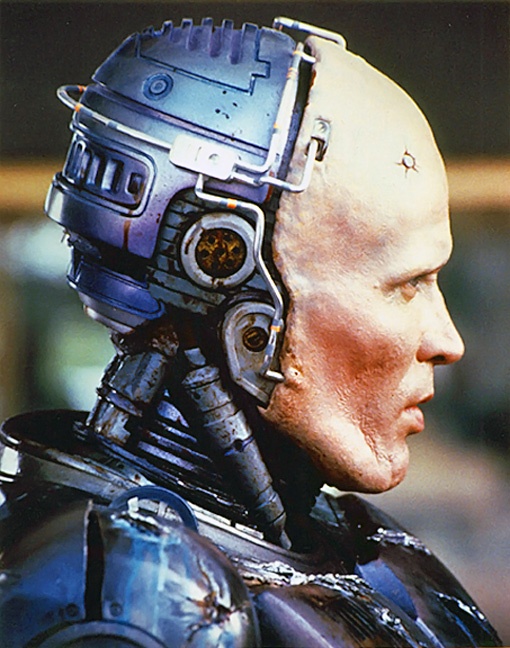
2. Human face stretched over robotic skull.

3. Underlying machinery visible through damaged dermal layer.

4. Subtle tech components on an otherwise mundane face.

5. One half of the head is dominated by bulky machine apparatus.

6. Chunky helmet with insectile or horn-like antennae. 

7-10. No special features.

MOUTH

1. Metal jaws. Strong enough to bite through steel. 

2. Crackling speaker. Has 4-in-6 chance of successfully mimicking other voices and sounds.

3. Cathode ray oscilloscope that displays the cyborg's vocal waveforms. The oscilloscope can be modified on the fly to measure other sorts of waves.

4. Rubbery gas mask attached to the head with wires and tubes. Immune to poison gases and other inhalants. 

5. Looks normal but can open and expand to reveal a small cannon. 1d8 damage, range 120', can only hold one shot at a time. 

6. Cords and wires run up the trachea and into the lower jaw right behind the chin. The cyborg's voice has a tinny echo like it's coming from a loudspeaker, and can be amplified up to three times as loud as normal. 

7-10. Ordinary human mouth.
SPECIAL EYES 

Special eyes have the same visual ability as a normal, along with an additional benefit and a unique appearance. 

Roll d6. 1-3: One special eye. 4-5: Two of the same eye. 6: Two different special eyes.

1. A dark patch with two small lights at the center. Roll 1d6: the eye grants 1-2: Radar sense (to "see" sound waves). 3-4: Full-color night vision. 5-6: Ultravision.

2. Telescope eye. Sees up to three times as far.

3. A bright orange lens. Fires a laser beam, 1d6 damage and +1 (in addition to other bonuses) to hit.

4. A single-cut opalescent gemstone. Grants True Sight twice a day. True Sight can see through invisibility, detect objects and entities in the astral plane, and detect a creature's alignment and intentions. Shapeshifted creatures appear as their true form superimposed over their present appearance.

5. A big lens with a crosshair reticle across the surface. +3 bonus to ranged attack rolls. 

6. A flat white lens with thin concentric circles on the surface. Grants x-ray vision.

7. Subtle visual prosthesis that looks like a normal eye but with technical components replacing the iris. Can record up to 10 minutes of video. Includes a minuscule projector 

8. A dark red lens embedded deep into the eye socket. Grants "tracker vision," allowing the cyborg to perceive footprints, fingerprints, and other subtle bits of evidence that indicate where people were and where they went. Can also recognize individuals based on unique biological identifiers regardless of whether or not they're appearance is disguised or obscured.

9. A screen of colored glass hooked up to a small scanner device. Once activated, it tells the cyborg the target's HD, attack types/weapons, and any general strengths and weaknesses. Possibly grants other information as situationally appropriate.  

10. Techno-Visor. Possesses three random robot eye abilities. Replaces all other special eyes. 

HAIRSTYLE (if applicable)

1. Wild mane of hair standing on-end due to static electricity.

2. Huge neon-colored mohawk. 

3. Long, straight hair cut to perfect uniformity.

4. Color is a synthetic bluish white, otherwise styled normally.

5. Thick braided cords.

6. Untamed mess of knots and scorched patches.

7.  An undercut, lined up to a razor's edge.

8. Totally bald.


BIONIC ARMS

It is assumed that cyborgs have robotic components in all of their limbs. However, some limbs are almost completely mechanical and come with special features. 

Roll d6: 1-4: One bionic arm. 5-6: Two bionic arms. 

Roll d6 for each arm: 1-3: One feature. 2-5: Two features. 6: Three features. 

Results 1-6 have functioning hands, whereas results 7-10 do not. If a bionic arm has multiple features between the two different types, assume it can switch "modes" once per round.  

1. Armor plated. +1 AC bonus.

2. Retractible forearm blade. 1d6 damage. 

3. Rocket fist. 1d6+1 damage, range 240'. Attaches to the base of the forearm with a tough cord, making it so the fist can return to the arm and be used as a grappling hook.

4. Multitool hand. Functions as thieves tools, or whatever simple tool is necessary at the moment. 

5. Electric discharge. 1d6 damage touch attack. Deals an additional 1d6 damage to targets wearing metal armor. 

6. Energy beam. Mounted on the palm or extends out of the forearm. 1d8 damage, range 300'. Can't be fired for more than three consecutive rounds or else it overheats. 

7. Melee weapon. Roll d6: 1: Pincer. 2: Buzzsaw/chainsaw. 3: Drill. 4: Jackhammer. 5: Hook. 6: Other. 1d8 damage. 

8. Gatling gun. 1d10 damage, range 1000'. Ignores 3 points of armor. Holds enough ammo to fire for 10 rounds. 

9. Energy cannon. Roll d6: 1-2: Fires a pulse that detonates in a 20' explosion on contact. 3-4: Fires a beam in a straight line. Targets can save vs. breath weapon for half damage. 5-6: Fires in a cone. Range is reduced to 500'. Targets can save vs. breath weapon for half damage. 3d8 damage, range 1000'. Recharges on a 1 on a d6, rolled at the beginning of every round. 

10. Power arm. Intimidatingly oversized appendage with a vice-like attachment in place of a hand. Strong enough to punch through walls and crush rocks into dust. Attacks from the arm deal 2d8 damage, and it can throw boulders like a giant (3d6 damage) up to 200'. If this result is rolled, the bionic arm can have no other features.

BIONIC LEGS

Roll d6. 1: No bionic legs. 2-3: One bionic leg. Only roll d4-1 on the table below. 4-6: Two robot legs of the same type. 

0-1. Storage compartment. Bonus inventory slot/carrying capacity/etc.  

2. Concealed blades in the toe and heel. 1d4 damage. 

3. Concealed cannon. 1d8 damage, range 120', can only hold one shot at a time. 

4. Extendo-stilts. Extend up to 20'. Can move twice as far per round when the stilts are fully extended. 

5. Spring loaded. Maximum jump distance is 30'. 

6. Super fast. Intuitive design grants double movement speed. Can sprint for triple movement speed once per round as long as no other actions are taken. 

7. Jet boosters. Provide 10 seconds of flight. Only usable once every 10 minutes. 

8. Eight mechanical spider legs. Can climb up walls and ignore difficult terrain.


ADDITIONAL FEATURES

Roll d6. 1: No additional features. 2-3: One additional feature. 4-5: Two additional feature. 6: Three additional features. 

Roll d6 or choose where the features are located, if not specified (or if it's not obvious): 1-2: Mounted on the shoulder. 3-4: Wielded like a gun or shield, with retractable tubes and wires that plug into the forearm. 5: Mounted on the chest. 6: Mounted somewhere else, like the back, stomach, or forehead. 

Note: Unless otherwise noted, assume that each feature can be used once, after which it must "recharge" on a 1-2 on a 1d6, rolled at the beginning of every round. Alternatively, assume each feature has 1d6 "charges" remaining when the cyborg is encountered.  

1. Flamethrower. 2d6 damage, range 60'. Targets hit by the flamethrower must spend their next round to stop, drop, and roll or else they take another 2d6 damage. 

2. Ice beam. 1d10 damage, range 120'. Targets must save vs. paralysis of be frozen in place for 1d4 rounds. 

3. Sonic cannon. Emits a sound blast concentrated in a 60' cone. Everyone in range must save vs. breath weapon or take 2d6 damage and spend a round in a daze. A successful save means the target only takes half damage and is not dazed. 

4. Rail gun. 1d20 damage, range 1,200'. The amount of energy required to fire the means that the cyborg must remain inactive for 1d4 rounds after firing. 

5. Net launcher/hardening foam. Target is immobilized until a successful save vs. paralysis is made. A saving throw can be attempted at the end of each round. Range 30'.

6. Stun gun. Target must save vs. paralysis or be paralyzed for 1d6 turns. Range 60'.

7. Magnet beam. Deals no damage. Can pick up and move metal objects the size of a car or smaller. Range 100'.

8. Additional robot appendages that protrude from the shoulder blades. Look like big excavator arms or mechanical tendrils. Grant two additional melee attacks per round, each dealing 1d8 damage. The arms can grapple one creature each. 

9. Katana. Can be used to deflect incoming projectiles—the cyborg makes an attack roll, and if it is equal to or greater than the attacker's ranged attack roll the projectile is successfully deflected. 

10. Active camouflage. Functions like invisibility for up to one turn. Deactivates once the cyborg takes damage. Can be used twice per day.

11. Self-repair. The cyborg can deploy a cloud of nanobots to repair 1d6 HP per round for 6 rounds. Can only be used once per day, afterward the cyborg's body must produce more. 

12. Force field emitter. Absorbs 5d20 hit points of damage before deactivating. Can only be activated once a day. Force fields are completely impervious to laser beams and similar energy weapons. 

13. Spy drone. Transmits what it sees to the cyborg as long as it is within 10 miles. 

14. Smoke bombs. When activated, they produce a dense curtain of smoke in a 20' sphere.

15. Escape plan. Once activated, the cyborg's still-functioning head rockets off into the sky as the body self-destructs in a big explosion (like a fireball spell). 

16. Mutator pump. A big hose hooked up to a tank of neon green goo. When sprayed on a target, they must save vs. magic device or mutate. Range 30'.

17. Fear/tear/insanity/hallucinogenic gas. Targets must save vs. magic device or suffer the effects of the gas. Sprays in a 60' cone. 

18. Mecha wings. Retractable 10' cybernetic wings that let the cyborg fly as long as there is space for them to fully expand. 

19. Grenade launcher. 3d6 damage. The launcher has a range 250', and grenades explode in a 20' sphere. 

20. Tracking sensor. Fired like a normal projectile, range 120'. Alerts the cyborg of its position, as long as they are within (roll d3) 10/100/10,000 miles of each other. 

APPEARANCE OF ROBOT PARTS

1. Bulky, overbuilt industrial-grade machinery. Pure function over form. 

2. Smooth, fluid design. Sleek and aerodynamically optimized. 

3. Grotesque Cronenbergian biopunk. Machinery messily protrudes from flesh. 

4. Motley configuration of salvaged parts. Could be the result of long years of add-ons and replacements, or just parts strewn together from a trash heap. 

5. Inscrutably baroque mechanisms that all work in perfect harmony. Like something a clockmaker would hallucinate.

6. Weird components that emit strange lights and noises. Meant to mimic some alien physiology, close but not exactly analogous to our own.

7. Clean, bright metal parts that move with relentless efficiency. Coldly utilitarian. 

8. Esoteric apparatus arranged in according to a peculiar geometric scheme. Parts move and shift in patterns seemingly incongruous to the function of the machinery.

TEMPERAMENT

Though it might go without saying, these are suggestions and you are encouraged to come up with your own cyborg's temperament should the feeling move you. 

1. Flat, inexpressive, and completely detached. Only cares about accomplishing the matter at hand.

2. Mad and sadistic. Believes humans to be utterly inferior beings and takes great pleasure in making them suffer. 

3. Existentially conflicted. Doesn't know who they are or why they were created. Forever in search of answers as to the nature of their existence. 

4. Self-hating and melancholic. Considers themself to be a monstrous abomination. The hatred within themselves often manifests as hatred of the world at large, punctuated by long bouts of dramatic self-pity. 

5. Erratic and confused. Faulty coding and resurgent memories make the cyborg believe they are still tasked to carry out some nebulous original mission.

6. Ambitious and power-hungry. Always seeking new ways to improve their faculties and acquire more power.

QUIRKS

1. The cyborg must follow the commands of anyone that speaks a special activation phrase. 

2. The cyborg's visual sensors have trouble detecting striped patterns and certain bright color combinations. 

3. The cyborg's delicate internal systems are prone to overheating. The cyborg will shut down if the cooling vents on its back are obstructed.

4. A hard-wired morality index prevents the cyborg from killing an unarmed individual. It will self-destruct if it violates this protocol.  

5. Metal poisoning is causing the cyborg's human organs to fail. The cyborg will die if it does not spend at least four hours a day in its regeneration tank. 

6. Healing spells cause the cyborg's body to reject their machine parts, causing the cyborg to lose control of its limbs. 


Many weapon damage numbers were lifted from Carcosa, so thank you Geoffrey McKinney. 


Monday, February 15, 2021

The Moon


  1. A perfect disk of pure silver, perpetually spinning on its axis. It controls and channels the flow of magical energies based on its angle and proximity to earth. Wizards spend decades trying to discern its secrets, while master thieves dream of stealing it.

  2. A prisoner bound to the earth by a great adamantine chain. It pulls against its shackles, forever seeking to escape our orbit. Mysterious cults spring up every few decades with catastrophic schemes to set it free.

  3. A massive egg of some unknowable celestial entity. Every new crack on its surface heralds era-defining upheaval. 

  4. A sigil of chaos; the greatest of the Marks of Discord are circumscribed across its surface. The forces of chaos grow and recede in power to match the moon’s cycle, becoming the most potent when the moon is at its fullest. 

  5. A purgatorial realm of milk-white cities and crystalline spires. It is the intermediary space between the real and the unreal. Spirits and astral entities congregate, souls of the deceased await their passage to the beyond, angels repose before being called again to duty, and spells manifest in physical forms in to acclimate to our reality. 

  6. The head of an ageless being. Or perhaps the being itself is just a head? It has a pale, moony face with wispy fronds of mist that form a sort of hair. Sometimes it’s a man, sometimes it’s a woman, sometimes it’s something else entirely. It’s rather lonely and appreciates having people to talk to, but has a hard time relating to mortals. Occasionally gets mournful and sullen. Has a vast, terrifying wealth of knowledge, relatively little of which is relevant or useful to anyone. 

Friday, January 22, 2021

The Sinister Clown class

I've been thinking about this idea for months now. Clowns are just one of those things that people love, hate, and love to hate all at once. Goofy yet grotesque, sinister yet charming. Since most people have little to no contact with real clowns on a day-to-day basis, the ubiquity they have in culture is pretty remarkable. People are drawn to clown characters in fiction—especially villainous ones. 

Even though evil clowns more or less all have the same schtick, something about them just draws people in. Part of the reason why is because clowns can be cool, and goofy, and threatening, and just generally unpredictable, and it all "works" within the character archetype. Shakespeare knew this; it's why the fools in his plays can be the comic relief but also shed the pivotal insights or left-field perspectives that turns things around for the main characters. This is great for villains, who must be vile while still captivating (if not relatable, sympathetic, etc.). That mystique, the needle clowns thread so nicely, is at least in part of the reason why they work so well. 


Does this make them good D&D characters? Maybe. Here's two reasons why I think they might:

A. Think about the long-time D&D characters you are familiar with. Think about all the different behaviors and mannerisms the player (maybe you?) made the character exhibit over the course of the game. Are they not themselves agents of chaos, playing at the margins of the world's assumed reality? Do they not behave in a way that suggests deeper understanding of the invented reality than those around them? Does their occasional breaking of the fourth wall serve to complicate the underpinnings of the narrative? Clowns, jesters, and fools of all sorts, have many thematic overlaps with PCs. By containing such multitudes, as described above, the clown highlights the contours of a story in a way that PCs do almost compulsively. In turn, the evil clown archetype perverts the fool's metanarrative position through exploring what happens when insight into the absurdity of one's reality leads to crazed malevolence—which, again, is something that some PCs act out almost compulsively. Instead of letting players fly off the tracks by being ultraviolent murderhobos, the formal structures of a PC class allows one to harness such impulses while while still operating within and around the gameplay loop.

B. People like evil clowns. 


SINISTER CLOWN

To the outside world you are a cheery if slightly off-putting clown with a sharp wit and an easy laugh. But inside you is a maelstrom of indescribable horror; a whirling universe of evil and darkness so twisted it exceeds mortal comprehension. You jape, you laugh, you make a fool of yourself for the enjoyment of others, but behind your smiling face is an terrifying lust to enact your unspeakably violent machinations upon the world. Your sinister intentions are convoluted beyond reason, but for the time being you choose to play the role of an adventurer.   

1d6 HD, saves and armor restrictions as a Thief.

XP progression and attack bonus as a Fighter. 

TOOLS OF THE TRADE. You can only wield knives and clownish improvised weapons, which in your hands deal 1d4 damage. 

CLOWN LOGIC. Your very being is slightly out-of-step with the rest of reality. You abide by your own laws of nature, which occasionally defy standard probability and causality in favor of more humorous outcomes. This has little to no mechanical impact on the game, but the player is free to propose specific outcomes or actions that would be otherwise impossible or highly unlikely. The DM can go along with these outcomes as long as they think it’s funny. All class abilities work because of CLOWN LOGIC except for MAGIC TRICK, which is actually just magic.  

TWISTED MIND. You have no soul—at least not in any recognizable form. Magic and other supernatural effects that target the mind don’t work on you. As a consequence, you are not recognized by the gods and thus cannot benefit from Cleric magic.

HARLEQUINADE. You are remarkably good at manipulating the feelings of others, whether through cheerful humor or harsh, biting insults. You get +1 loyalty and +1 to reaction rolls when attempting to hire retainers and hirelings, and intelligent enemies with equal or fewer HD to you get -1 on morale checks. 

PATRON. You are in the employ of a powerful patron. The patron must be of lawful alignment and must have at least 9 HD. The patron can be a lord, a powerful wizard, or a high-ranking member of the clergy, but they could also be a dragon, a sphinx, genie, or other such creature. The patron is unaware of your true nature. The terms of your patronage are up to you and the DM to decide, but you must spend at least four weeks of downtime out of the year (doesn’t have to be consecutive) doing stuff for your patron. In return, they provide a stipend that is just enough to cover living expenses and upkeep. 

Why are you adventuring? Your patron might want you to act as a spy or seeker of information, or perhaps they want you to track down a specific person or thing. Or maybe they just want you to go on adventures so you can come back and regale them with tales of your exploits and jokes from foreign lands. Or maybe some other reason. Whatever it is, your mission is secondary to the evil machinations you’re working toward. You know that your patron is somehow pivotal to your plans, which is why you got close to them in the first place. You are unable to ascend to 9th level unless you kill your patron.

SHOCKING TWIST. When you reach 0 HP or are put in an otherwise debilitating situation (basically, whenever you would lose your character and roll up a new one), the clown miraculously survives and becomes a villainous NPC under that DMs control, to reappear at a time of their choosing. This happens regardless of how the clown “dies,” and any precautions the PCs take will be futile. If the clown’s body was completely destroyed, it would turn out it was just a double. If the PCs witness the clown’s demise and carry his corpse around in a locked chest, they will find at some point later on that the chest was forced open and the poor sucker they hired to keep an eye on it mysteriously died. 


In addition to all of this, roll 1d10 for an ability every other time you level up.


1. MAGIC TRICK.

From the chaotic darkness of your mind, you have gleaned a few tricks for manipulating occult power. Learn three first-level MU spells. You can cast each spell once per day. 


2. HATCHET MAN

The gag weapons are funny, but it’s time to get down to business. You can now wield axes and giant hammers. Using them makes you go into a frenzy, giving you a +1 bonus to damage but a -1 penalty to attack rolls. When you’re using a hammer or axe you must attack a creature every round or else spend your entire action laughing maniacally. 


3. UNKNOWABLE FACE

You can now remove your clown makeup. Your “natural” face is utterly, completely forgettable. No one can recognize you, and things you say or do leave almost no impression. People mostly forget you as soon as you leave their sight. You can only last one hour per day without your makeup on, after which greasepaint residue begins to form on your skin, returning you to your original form. 


4. PRATFALL MASTER

You develop an expertise in the esoteric art of tumbling. You can no longer die from taking fall damage. Instead, you become inert for a number of minutes equal to the amount of fall damage that would have put you past zero. For example, if you had 10 HP, fell 30’ and rolled 15 damage, you would be unconscious for 5 minutes. No healing or other magical effects can circumvent this. Additionally, you can choose to fail any ability test or saving to determine whether you fall, trip, lose your balance, or otherwise move against your will. Whenever you fail any of these rolls, you can move 10’ in a direction of your choosing and do one non-attack action like chug a potion, light a torch, or fish something from your backpack.


5. INSANE MURDER RAGE

The ego facade that keeps the vast, horrifying ocean of bloodlust at bay becomes all the more fragile. When you get hit with an attack, after damage is rolled, you can willingly choose to take double damage to “snap” and become overwhelmed by a terrible lust for violence. This happens automatically if the attack roll was a natural 20. You get a +1 damage bonus for melee attacks, and if you successfully land a hit you can choose to make another attack with an additional cumulative +1 damage bonus. You can continue doing this a maximum of five times or until you miss, at which point you take damage equal to the number of extra attacks you made and are unable to act for that many rounds. You must attack every round if able. The murder rage lasts until all the enemies have either died or fled, or if you are no longer capable of attacking. 


6. PESTILENT LAUGHTER

If you spend 10 seconds doing nothing but laugh, everyone who can see and hear you must make a save vs. breath weapon or else stop what they’re doing and laugh along with you. You can choose to prevent your allies from being affected by your laughter. Creatures that have failed their save will laugh either until they take damage or you stop laughing. After you stop laughing, everyone else will continue to laugh for another 10 seconds. Creatures that are laughing can’t move or attack and get a -2 AC penalty because they’re cracking up too hard to defend themselves. Creatures that are mindless or incapable of laughing are unaffected. 


7. MADDENING CONTORTIONS

You can twist and bend your body into spaces it shouldn’t be able to fit. You can fit into a space as small as 2.5 cubic feet for a number of turns equal to your Dexterity score plus your level. You can also squeeze through excessively tight spaces that would normally be inaccessible, down to the size of a letterbox. It takes one turn to move one foot while squeezing through such tight spaces. 


8. KNOW FEAR

You are an expert at psychologically tormenting your adversaries. After interacting with an intelligent creature for at least a turn (in combat or otherwise), you can attempt an Intelligence test with a penalty equal to the creature’s Hit Dice. You gain a +1 bonus to the Intelligence test for every additional turn you spend interacting with the creature after the first one. If you succeed, you learn the creature's deepest fear or insecurity. If you fail the test, you do not gain any insight into the target’s psyche, and they become aware that you are trying to mess with them. You can make one attempt per creature per week, and you can only build up a bonus against one creature at a time. 


9. MOCKING PANTOMIME

You can perfectly mimic the voice, actions, and mannerisms of a target you can see. Additionally, you can perform a pantomime act so convincing that to others it may become real. You can pantomime using a simple tool or interacting with an aspect of the environment (like a wall) that is not actually there. Intelligent creatures that can see you must save vs. magic or else, to them, the thing you are pantomiming is entirely real. For instance, if you pretend to throw a lasso around a creature and they fail their save, they will behave as though an actual, tangible lasso has been thrown around them. Things you pantomime do not truly exist, so projectiles and aspects of the environment are unaffected. The illusion persists for as long as you are performing the pantomime, or until the targets realize what you are doing. You cannot talk while performing a pantomime. 


10. DIVINE COMEDY. 

Up to once per day, you can cast a spell as a Cleric of your level. The spell does not need to be memorized; you can cast it spontaneously from the Cleric spell list. Once you use this ability, you can’t use it again until you do a substantially good deed so that you don't draw too much deific attention to yourself. There is a 50% chance that religious devotees you are not allied with will consider you a blasphemous abomination if you use this power in their presence. They will either attempt to kill you on the spot or flee and warn the nearest religious authority. Whether this ability implies that you can trick the channels of divine power into granting you magic reserved only for the chosen, or that the gods don’t work in the ways we typically think they do, no one can say for certain. 


Monday, January 18, 2021

Simple method for hidden rolls

December kicked my ass well into January. I'm sure I'm not alone there. Anyway, I'd like to start off the new year (18 days in) with a quick tip for making hidden rolls marginally more engaging to players.

This is great for D&D, where even in the lightweight early editions have a lot of dice rolling. But one of the things that chaps me about the rules is the amount of dice rolling the DM has to do behind the screen during the game. Random encounter rolls, listening and searching rolls, some thief skills, and so on. (If you're reading this, you probably are in the vanishingly small subset of the population that knows exactly what I mean so I'll spare further explanation for the sake of preserving in-group identity). 

This is for good reason. If a player wants to search an area for a hidden door but don't find anything, it makes sense that it could either be because they didn't look well enough or because there wasn't one there in the first place. 


According the rulebook you're probably using, the player dictates they want to listen at a door, the DM rolls in secret, then tells them that they can't hear anything other than the ambient sounds of the dungeon. The players shrug, spend a couple seconds looking at each other, and then decide to have their characters move on. This is fine, but TO ME it feels like less of a game. 

The DM just explaining stuff? In this attention economy? Me and my cohort of young tech-addled zillenials have too much going on in our oversaturated brainspaces for that. Give me dice, it's the closest thing to a fidget toy I have in arm's reach. 

The buttons players' have to press, the gameplay mechanisms that allow them to interface with the game world, ought to have dice rolling procedures for the players attached to them. Otherwise the gameplay abstraction blurs the line between actual gameplay, roleplay, and DM fiat. In our simple lizard brains, rolling dice = playing the game. When something has a dice roll attached to it, it becomes "part of the game." Even if it was part of the game to begin with. The dice roll is just a signpost, a way to tell players "Look, the game is here. These are the sorts of things you can and ought to be doing in D&D." 

The only reason why these hidden rolls don't have players rolling dice in the first place is because players should be left in the dark about whether they succeeded or failed when it isn't already obvious. So if you, like me, feel that the game should ever-so-slightly shift to satisfy your niggling desire for consistency in the level of engagement players get from gameplay mechanics, here's what you should do:

Whenever a player gets in a situation where the rules dictate you (the DM) make a hidden x-in-6 roll—like for listening at a door, searching an area, hiding in shadows, etc.—have the player roll at the same time as you. Their dice is out in the open, yours is not. If you get the same number, they succeed. This is functionally identical to rolling a d6 behind the screen with a one counting as a success. If the success chance is higher than 1-in-6, just roll more dice behind the screen. If you get doubles—well shit, just re-roll one of them. 

This method accomplishes almost nothing other than A) players get more opportunities to roll dice, while B) it preserves the mystery of negative outcomes, meaning players could have failed or if there was simply nothing to hear/find/hide from. 

Sometimes, though, that's enough. 


Thursday, November 26, 2020

Blood Silver

To a mundane eye, silver gleams the same as any other precious metal. Its luster arouses a deep-seated yearning in our minds, an innately human drive to seek beauty—and covet it.

But to other beings, silver is something different. All metals have qualities beyond humans' base understanding, but by far the most formidable, and most feared, is silver. 

To some it scalds like hot iron, to others it enfeebles like a disease. To some it doesn't even bring pain, but instead has a sort of narcotizing effect. To these beings its touch brings forth indescribable sensations somewhere in the range between feverish nausea and maddening ecstasy. 


Ironically, silver possess an additional, unique quality that makes it sought after by the very beings affected by its hidden potencies: it can trap and contain living souls. 

It is, of course, one of the gravest mortal sins to capture souls and prevent them from passing on. But those who know the occult properties of silver and the esoteric means with which they can be employed often pay little heed to what is and isn't sinful. 

A soul is a useful thing, made all the more scarce by its ephemeral nature. Having reliable means to store and trade souls is invaluable to those who could make use of such a thing. It is so cherished, in fact, that many would be willing to suffer the ill effects of silver just for the sake of possessing a soul.


Any amount of silver that contains a soul is known as "blood silver." The smallest amount of silver that is capable of holding a soul is equivalent in size to a standard coin. 

There are several dark and esoteric methods of creating blood silver, the most common being the most straightforward. It goes as follows: place a coin in the victim's mouth and stab them through the heart with a ritual knife. As the victim breathes their dying breaths, their soul will be trapped in the coin.


Blood silver is indistinguishable to humans from normal silver. It can only be recognized through identifying magics. Demi-humans can recognize blood silver on sight, and demons, fey, intelligent undead, and certain planar outsiders can sense its presence even without even seeing it. 

***

Blood silver coins function kind of like the coins from John Wick, but for magic users and beings of chaos. Most demons/fey/etc. can only carry 1d4-1 blood silver coins per HD at one time, but more powerful entities often have large stores blood silver and use their thralls to handle it when the need arises. Chaos entities, who typically have no use for mundane currency, can be bribed and persuaded with blood silver according to their disposition just like common folk with normal currency.

For spell research purposes, one blood silver coin is equivalent to 100 GP. Depending on your alignment system, using blood silver this way is considered a chaotic or evil act.

Thursday, November 19, 2020

Doing Combat Maneuvers & Improving Fighters

This is how I do combat maneuvers and make fighters suck less in B/X (or whatever).

When you want to do any sort of combat maneuver, you and your enemy both roll 1d6 + your level/HD. Fighters have a WARRIOR’S INSTINCT which allows them to to add their attack bonus to the roll. If you roll higher than your opponent, you succeed in whatever you were trying to do (within reason, of course). 

Fighters can use ADVANCED TACTICS to attempt a combat maneuver while simultaneously making an attack. The success of either is independent of one another, so a Fighter can miss an attack but still do something like disarm their opponent and vice versa. They can do this a number of times per battle equal to their level. 

As a special bonus houserule-of-a-houserule (in that I haven’t tested this substantially enough to say if it enriches the original rule), if a Fighter misses their attack but succeeds on the maneuver, they can forego their maneuver and add the dice result (no modifiers) to the attack roll. This probably would get pretty broken at higher levels when a Fighter could just get a +d6 bonus on every attack so maybe this only works once a battle. SO FAR it has not been much of a problem, though. 

Examples of combat maneuvers:
Grapple: Grappled creatures can’t move, both you and the grappled creature get a +1 bonus to hit each other, and the grappled creature can’t target other creatures. The grappled creature can forego an attack to attempt another contested d6+HD roll.
Disarm: If you beat the contested roll by 1-3, the weapon simply falls to the ground. Beating the roll by 4 or more means you knock the weapon 10’ in a random direction. Creatures cannot pick up a weapon and attack on the same round.
Shove: Beating the roll by 1-3 means the creature is knocked 10' straight back, whereas beating the roll by 4 or more means that you can heave them left or right as well.
Knock Prone: Melee attacks against prone creatures get advantage but ranged attacks get disadvantage (like in 5e). Getting up counts as your movement for the round. 
Stagger: Knock the target off balance, giving them -2 AC until next round.
Intimidate: Force a morale check against a single opponent.
Called Shot: If you succeed on the roll, the next time you successfully attack the opponent you can target a specific area on their body.

***

Why do it this way and not like one of the many hundreds of other fighter fixes that have been proposed before?

This method is more interesting than piling on static bonuses, less situation-dependent than just giving fighters cleave (or an equivalent feat-like ability), and makes combat more interesting with minimal extra crunch. Early D&D is not a tactical game and shouldn’t be treated as such, but giving players more options reason allows for more dynamic combat without sacrificing speed and flow. 

Instead of making the numbers higher or letting Fighters do a specific thing in a specific situation, I want players to feel like they have effective options beyond just heaping on damage. Allowing more viable options for how players can interact with the enemy in a combat situation benefits the game overall. 

All combat maneuvers can be adjudicated by DM fiat, but when you prescribe discrete mechanics it serves as an impetus for players to actually try them out, because they become “part of the game.” 

And while letting Fighters execute combat maneuvers and normal attacks at the same time may seem like a hefty bonus, I found that when you just give players the option to bring a monster closer to death or do some other thing that might or might not make it easier to kill, players would choose to just do damage nine times out of 10. So instead of making the alternatives to attacking better, just let them do both at the same time. Simple as.


Tuesday, November 10, 2020

D8 Tools of the Metal Waste Scavenger

The Metal Waste is a wasteland in a literal sense, where the inscrutable refuse of a time-lost culture (advanced far beyond our own) accumulated over untold centuries. The Waste was inevitably abandoned after the civilization fell, and has since been left to the whims of time. 


As the ages passed, strata gathered atop the refuse like paint on a canvas. The land is harsh and gray, barren due to the chemical slag it covers. The only evidence of the long-buried refuse are bits of metal and glass found among the pebbly ground, and a faint charge in the air that makes your hair stand on end. 


At least that is the common story. But anyone who’s been to the Metal Waste knows that the truth is much stranger. Crooked spires and pylons protrude from the earth, hinting at the larger mysteries buried below.


Inconceivable discoveries have been made by those brave enough to venture into the wasteland’s decaying heart: beneath the strata of gray, ashen earth lie labyrinths of maddening geometry; organized structures far bigger than any known today, built by methods long lost to mankind. And hidden in these structures are said to be strange and terrible things: legions of ancient men preserved in crystal coffins, fetal stars bound in adamantine cages, and treasures whose very nature lies at odds with our understanding of the world. Of course, that is what these scavengers claim. 


Most of what is found in the Metal Waste is trash. Dangerous trash, but the danger is manageable as long as you know how to deal with chemical burns and radiation poisoning. Even trash can have its value. There’s enough scrap metal buried down there for an eager scavenger to earn a king’s ransom, and even better are the baubles and curios, always broken beyond repair, that are given new life after being deconstructed and repurposed. 


These become the tools of the scavengers, which are used to delve even deeper into the wastes and discover even more decrepit wonders. 


Each tool can be used 1d6 times a day, after which they must recalibrated the next morning. If a character is skilled with machines, their Intelligence or tinkering bonus gets applied to the 1d6 roll.


  1. Extend-o-hand: A skeletal metal hand connected to a series of thin, interlocking strips of metal that fit on the back of the forearm like a bracer. The metal strips can unfold and extend up to 10’, and the fully articulated hand can be controlled by an intricate wire system controlled by the wearer’s fingers. This increases the reach of one of your hands by up to 10’, although you can’t use it to lift heavy things or effectively use a weapon. The hand can support the weight of a fully grown man and not much more, despite repeated attempts by tinkerers and artificers to modify the design.
  2. Spring boots: Actually clockwork components that strap over regular boots. Clicking the heels together primes the mechanism, launching you 10’ into the air 10 seconds later. Leaping with the launch sends you 20’, and a running jump launches you 30’. The boots are a lot of fun to use, although many ankles have been sprained and knees dislocated by foolish scavengers who got too carried away.
  3. Glide pack: A slim backpack that can deploy two membranous, wing-shaped parachutes. The parachutes negate the first 100’ of fall damage, and allow the wearer to move 5’ horizontally for every 10’ of falling. Despite the value it has for preventing tragic falls, relatively few scavengers bring them on their excursions because they can’t wear a normal backpack with it on. Given a decision between safety and the potential for bringing home more loot, the choice for most scavengers is clear.
  4. Light belt: A thick wire belt with two luminiferous gaslights mounted on either side. Both lights together have the same illumination as a torch, and they leave your hands free. Both lights can be shuddered and adjusted to only shine forward like a hooded lantern. One usage lasts 30 minutes. Scavengers frequently decorate these by hanging small trophies and mementos found off of them.
  5. Multiform implement: A small handheld device, about the size of a deck of cards, made up of several rectangular sections. The sections can shift and unfold to reveal various tools and mechanisms, like a steampunk leatherman. Functions as thieves tools that grant a +15% (or +1 in a 1d6 system like LotFP) bonus to picking locks and disarming traps. It can also do everything a typical multitool or Swiss army knife can do. No two are exactly alike.
  6. Magnet grenade: A dark metal ball with two shiny bands crossing its surface. When triggered, it creates a pulse that draws all magnetic objects in a 30’ radius. Can only be used once a day, and has a 2-in-6 chance of irreparably breaking each time it is used. They are generally frowned upon in the Metal Waste as they can cause unintentional damage to the buried megastructures and occasionally lead to catastrophic collapses.
  7. Crowjack: A cross between a crowbar and a car jack. The wedge expands as the handle is cranked, allowing stuck doors to be opened and heavy loads to be lifted with ease. Has a 5-in-6 chance to open a stuck door, and generates no more noise than someone walking around in chainmail. On a 1, the door breaks and is unable to be closed again. Only recently invented, many older scavengers scoff at them and claim that they take some of the spirit out of exploring the ruins. 
  8. Grapple claw: A claw-like grappling hook connected to an arm-cannon by a length of thin chain. Works like a hook shot from Legend of Zelda. The claw can be shot up to 60’; if it latches to something heavier than you, it pulls you closer. Vice versa if it latches to something lighter than you. If it hits something fragile, the object will break it. The chain can also be set to raise or lower slowly, so you can use it to climb and lower yourself safely. It can support the weight of a fully equipped full grown man. These are the most coveted tools in the scavengers arsenal, but also the hardest to get ahold of.

For pricing, any one tool would go for 2d4x100 SP (silver standard) except for the grapple claw, which is twice the price. That being said, scavengers rarely sell their tools and would rather trade for something useful or valuable.


For murderhobo purposes, treat scavengers as Thieves/Specialists with 1d6 HD and two random tools, plus a 50% chance of an additional tool for each HD above 1.